
Victron · dual AC sources · controlled resilience
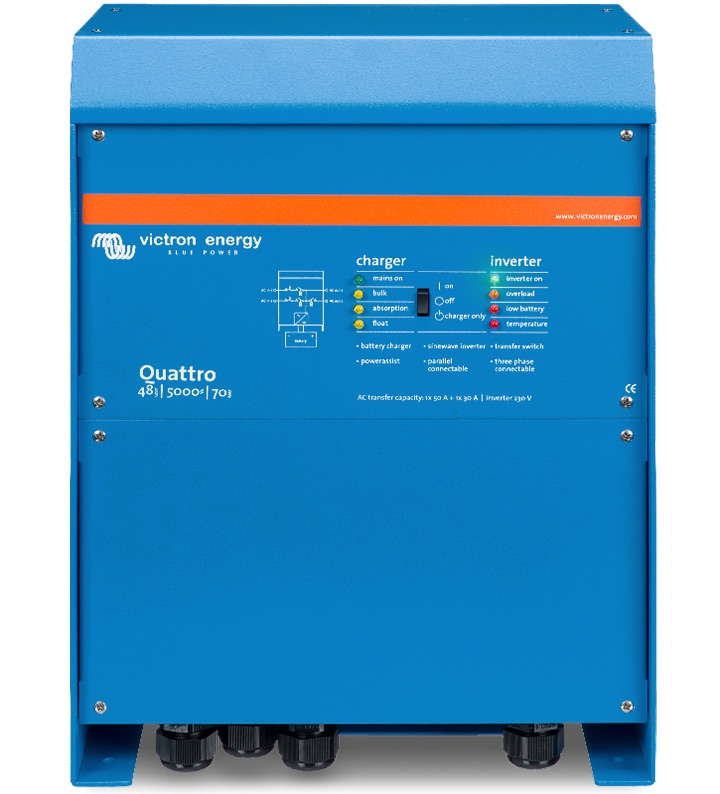
Victron Quattro for commercial ESS and backup systems
Quattro is not a complete battery system. It is a powerful building block for projects that must coordinate the grid, a generator, batteries, solar and critical loads without relying on site improvisation.
Decision snapshot
This is not a retail bundle or a blanket compatibility claim. Components are candidates; only the project specification is binding.
Decision page · updated September 2026
What the technology or architecture actually solves
The defining feature is the pair of independent AC inputs and automatic selection of the active source. This supports a clear grid-plus-generator architecture, controlled input-current limits and PowerAssist during short demand peaks. Parallel and three-phase operation can reach tens of kVA, but it also makes firmware alignment, protection, cabling, DC distribution and black-start sequencing part of the design.
The current family spans 3, 5, 8, 10 and 15 kVA classes. Selection is not based on the sum of nameplate loads. We study motor starts, phase imbalance, allowable AC input current, autonomy, part-load efficiency and the battery bank’s ability to provide transient current without a BMS trip.
Practical business scenarios
production equipment with a generator and controlled grid return
server or controls rooms with a defined critical-load bus
weak grid connections where storage supports demand peaks
microgrids with AC-coupled PV and local supervisory control
Control and automation
A Cerbo GX or another GX device can bring together metering, alarms, VRM monitoring and generator start/stop. Automation still needs a safe local fallback: loss of internet must not disable essential source transfer. We define grid, battery and generator priorities, emergency SOC reserve, warm-up and cool-down, and the exact conditions for shedding non-critical loads.
Weak points we test
Two AC inputs do not make every load uninterruptible. Transfer time and the behaviour of PLCs, variable-speed drives and IT power supplies have to be tested; a separate UPS layer may still be required. Multi-unit systems also need loss-of-one-module, maintenance-bypass and manual-recovery tests.
Legal, regulatory and data context
For EU projects we map grid connection, metering, storage operation, cyber access, update ownership and incident evidence. Where NIS2 or sector rules apply, the engineering evidence can support the legal workstream, but it is not a blanket legal opinion.
Frequently asked questions
Is Quattro an industrial UPS?
It may form part of a resilient supply, but transfer performance must be verified against the actual loads and continuity requirement.
Can the system be expanded?
Yes. Parallel and three-phase arrangements are possible, provided DC distribution, protection, firmware and controls are engineered for the final topology.
Primary sources and fact check
Product data, firmware, certification and compatibility change. The exact model, revision, market and current documentation are reconfirmed before a binding design.
Related commercial and regulatory context
Related decision maps
Victron · 48 V ESS · price-aware dispatch
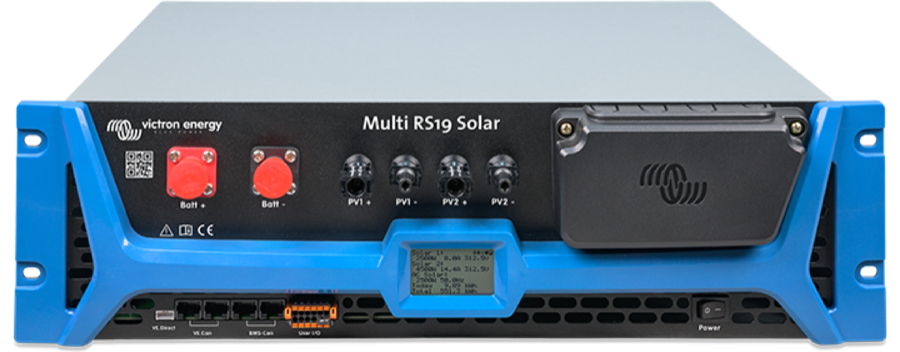
Victron Multi RS, RS19 Solar and Dynamic ESS for business
Multi RS is a lightweight 48 V platform for retrofit storage, backup and controlled self-consumption. RS19 Solar adds a rack format and two independent MPPTs; the real system…
Open decision page →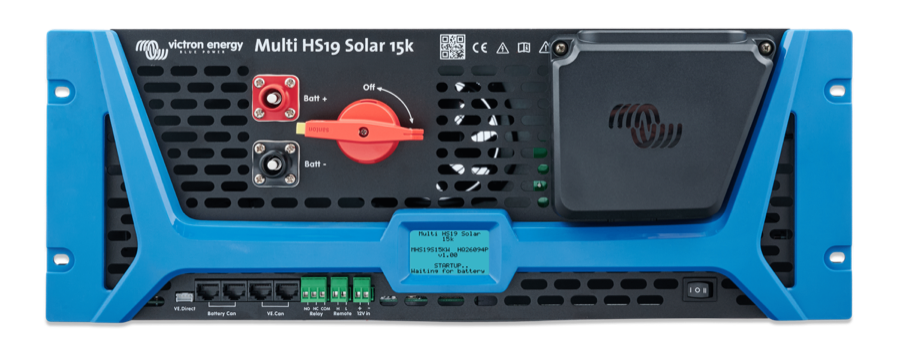
Victron · high voltage · three-phase ESS
Victron Multi HS19 Solar 15 kW for commercial BESS
Multi HS19 Solar 15k brings the Victron ecosystem into a high-voltage three-phase architecture. It is a candidate for compact C&I ESS only when the exact battery voltage window,…
Open decision page →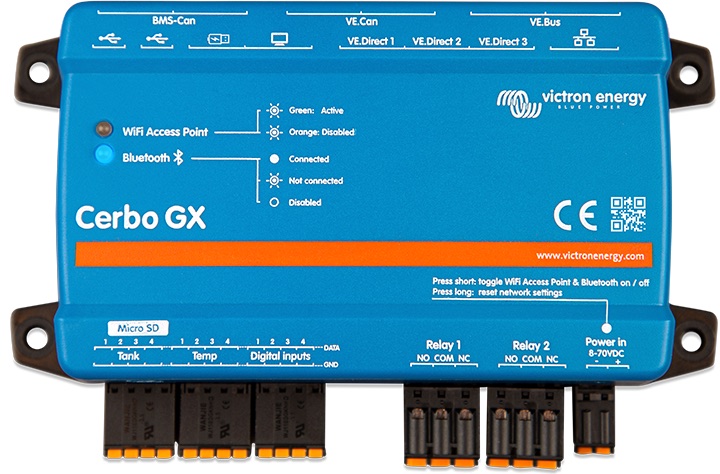
Venus OS Large · local automation · EMS
Victron GX and Node-RED for business energy automation
Cerbo GX, Nucleo GX and Venus OS Large can connect energy data to local Node-RED automation. The value is not a colourful dashboard; it is measurable operating logic, a safe…
Open decision page →First step without choosing a brand
Tell us what must not stop and what the system must deliver.
We start with data, project boundaries and the decision. The bill of materials follows power, energy, risk, legal and service review.