
Victron · high voltage · three-phase ESS
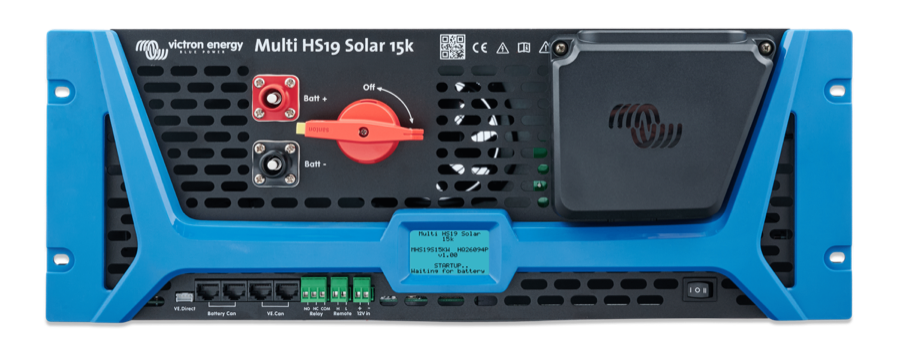
Victron Multi HS19 Solar 15 kW for commercial BESS
Multi HS19 Solar 15k brings the Victron ecosystem into a high-voltage three-phase architecture. It is a candidate for compact C&I ESS only when the exact battery voltage window, CAN communication and protection states are verified.
Decision snapshot
This is not a retail bundle or a blanket compatibility claim. Components are candidates; only the project specification is binding.
Decision page · updated September 2026
What the technology or architecture actually solves
The unit combines a 15 kW three-phase inverter/charger with four independent MPPTs rated up to 8 kW each. A 650–1000 V battery system reduces current and conductor size compared with 48 V, while increasing the importance of isolation, DC arc risk, measurement, service procedures and qualified personnel.
The manufacturer states up to 98% inverter efficiency and a 26.5 kg 19-inch package. That simplifies rack integration, not the whole project. The separate battery compatibility list shows that allowable voltage, module count and communication status vary by manufacturer and revision.
Practical business scenarios
15 kW three-phase ESS for small industrial or office sites
short-duration peak shaving with a high-voltage battery
backup of a selected distribution board with local control
multi-orientation PV using four independent MPPTs
Control and automation
We design around measured constraints rather than simply adding four 8 kW MPPT labels. The control layer must distinguish PV production, charge, discharge, export and backup reserve. GX/VRM provides supervision; an external EMS may add demand or price control, but safety limits remain local.
Weak points we test
An HV battery is not an interchangeable component. The exact model, module count, min/max voltage, pre-charge, isolation, CAN bitrate, master/slave topology and loss-of-comms response must be documented before compatibility can be claimed.
Legal, regulatory and data context
The review covers EU market-placement evidence for the industrial battery, future battery-passport readiness, grid connection, fire strategy and cyber responsibility for updates and remote access.
Frequently asked questions
Is 650–1000 V automatically more efficient?
Higher voltage reduces current, but system efficiency still depends on operating points, battery, cabling and auxiliary loads.
Can any HV battery be connected?
No. Voltage window, communications, protection and the manufacturer’s verification status must all match.
Primary sources and fact check
Product data, firmware, certification and compatibility change. The exact model, revision, market and current documentation are reconfirmed before a binding design.
Related commercial and regulatory context
Related decision maps
Victron · dual AC sources · controlled resilience
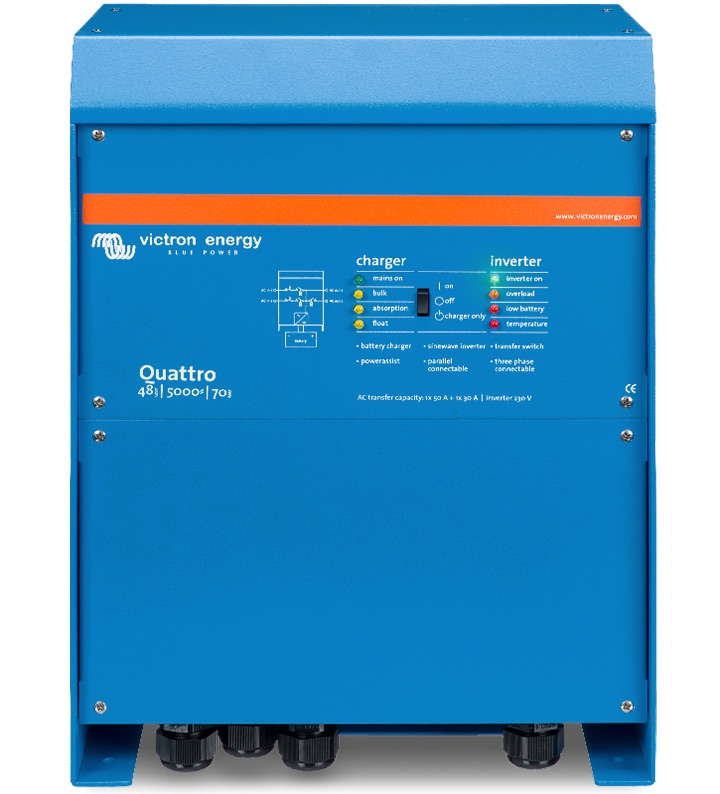
Victron Quattro for commercial ESS and backup systems
Quattro is not a complete battery system. It is a powerful building block for projects that must coordinate the grid, a generator, batteries, solar and critical loads without…
Open decision page →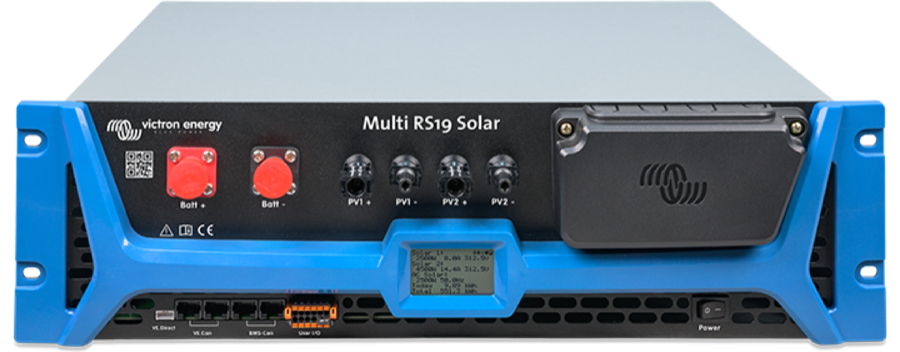
Victron · 48 V ESS · price-aware dispatch
Victron Multi RS, RS19 Solar and Dynamic ESS for business
Multi RS is a lightweight 48 V platform for retrofit storage, backup and controlled self-consumption. RS19 Solar adds a rack format and two independent MPPTs; the real system…
Open decision page →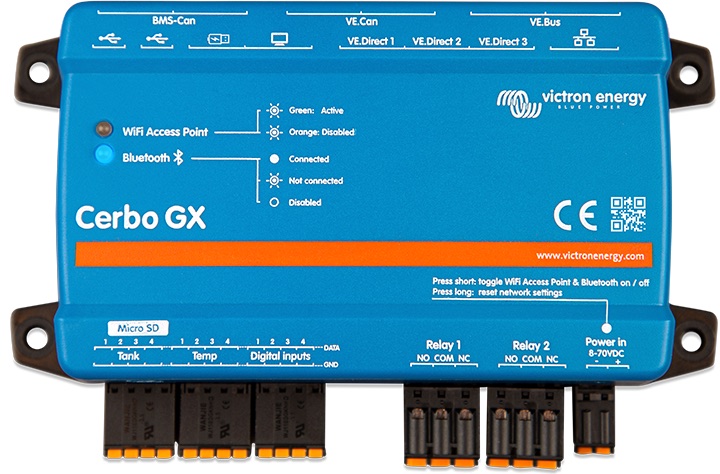
Venus OS Large · local automation · EMS
Victron GX and Node-RED for business energy automation
Cerbo GX, Nucleo GX and Venus OS Large can connect energy data to local Node-RED automation. The value is not a colourful dashboard; it is measurable operating logic, a safe…
Open decision page →First step without choosing a brand
Tell us what must not stop and what the system must deliver.
We start with data, project boundaries and the decision. The bill of materials follows power, energy, risk, legal and service review.