
Venus OS Large · local automation · EMS
Victron GX and Node-RED for business energy automation
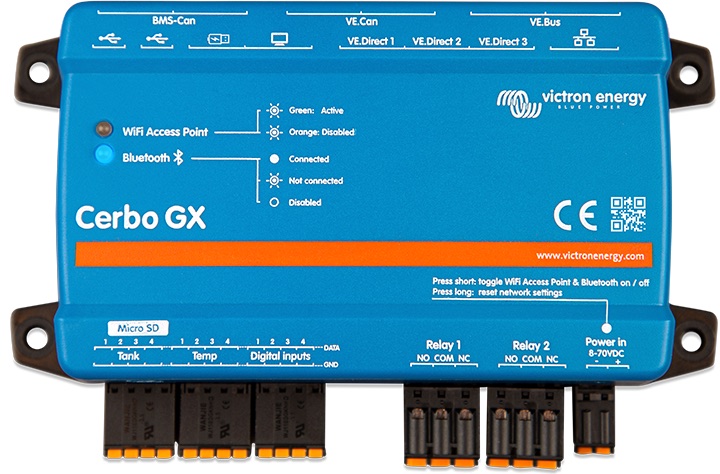
Cerbo GX, Nucleo GX and Venus OS Large can connect energy data to local Node-RED automation. The value is not a colourful dashboard; it is measurable operating logic, a safe fallback and an auditable change history.
Decision snapshot
This is not a retail bundle or a blanket compatibility claim. Components are candidates; only the project specification is binding.
Decision page · updated September 2026
What the technology or architecture actually solves
Venus OS Large adds Node-RED and Signal K to GX devices. Victron nodes expose batteries, inverters, meters and controllable relays while APIs, MQTT or Modbus TCP connect other systems. Nucleo GX is a fast focused option for VE.Can/VE.Direct projects, but it has no native VE.Bus port, relay or analogue input. A Cerbo GX can therefore be simpler and more reliable than a collection of USB adapters.
Current documentation refers to tens of thousands of Node-RED or Signal K systems, while making clear that advanced custom solutions are not supported by the manufacturer. Venus OS 3.70 added virtual switches linked to flows and multi-property updates for virtual devices, reducing flow complexity and CPU work. FlowFuse Dashboard 2.0 is the maintained dashboard recommendation; the old node-red-dashboard is deprecated. Flows and credentials need a verified backup before firmware updates.
Practical business scenarios
holding a quarter-hour demand ceiling through an ESS setpoint
pre-charging against production, price or a planned outage
generator start with warm-up, minimum runtime and cool-down
dispatching EV chargers, heat pumps or non-critical process loads
Control and automation
A practical flow combines battery SOC, grid power, time, price, PV forecast and production state. It first rejects stale data, evaluates the condition, rate-limits changes and writes the setpoint. A separate watchdog branch returns the system to a conservative state when inputs fail. Alarms are stored with time, original value and operator action.
Weak points we test
Node-RED must not bypass certified protection, the BMS or emergency shutdown. Remote access should use VRM or a managed VPN; the editor should not be exposed directly to the public internet. Every flow needs an owner, version, test case, backup and recovery plan after a Venus OS update.
Legal, regulatory and data context
Operational data from connected products can trigger contractual, security and data obligations. The EU Data Act has applied since September 2025 and strengthens user access to connected-product data. For regulated organisations, architecture evidence can be mapped to NIS2 and national cyber obligations.
Frequently asked questions
Does Node-RED replace a PLC?
It can handle selected supervisory and non-safety functions, while safety and hard real-time control remain in purpose-built local layers.
Can automation work without the cloud?
Core flows can run locally on the GX device. Cloud services may add supervision and data, but should not be the only condition for safe operation.
Primary sources and fact check
Product data, firmware, certification and compatibility change. The exact model, revision, market and current documentation are reconfirmed before a binding design.
Related commercial and regulatory context
Related decision maps
Victron · dual AC sources · controlled resilience
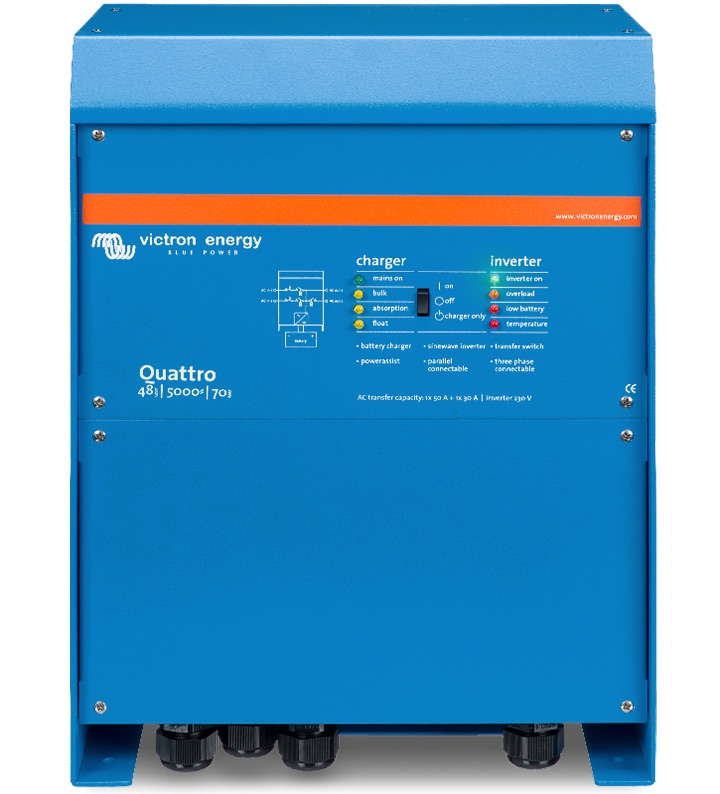
Victron Quattro for commercial ESS and backup systems
Quattro is not a complete battery system. It is a powerful building block for projects that must coordinate the grid, a generator, batteries, solar and critical loads without…
Open decision page →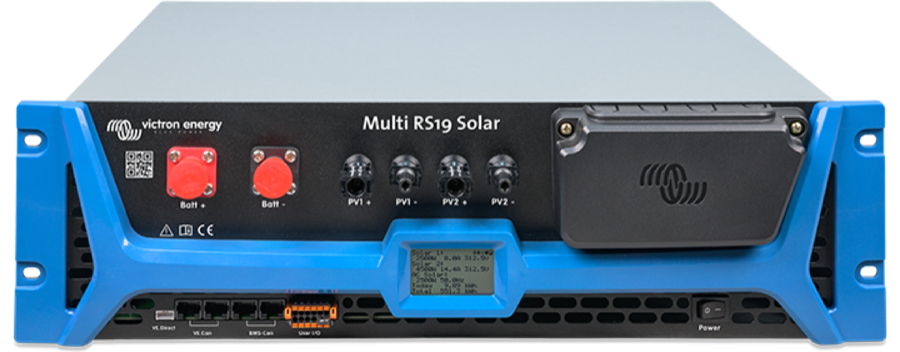
Victron · 48 V ESS · price-aware dispatch
Victron Multi RS, RS19 Solar and Dynamic ESS for business
Multi RS is a lightweight 48 V platform for retrofit storage, backup and controlled self-consumption. RS19 Solar adds a rack format and two independent MPPTs; the real system…
Open decision page →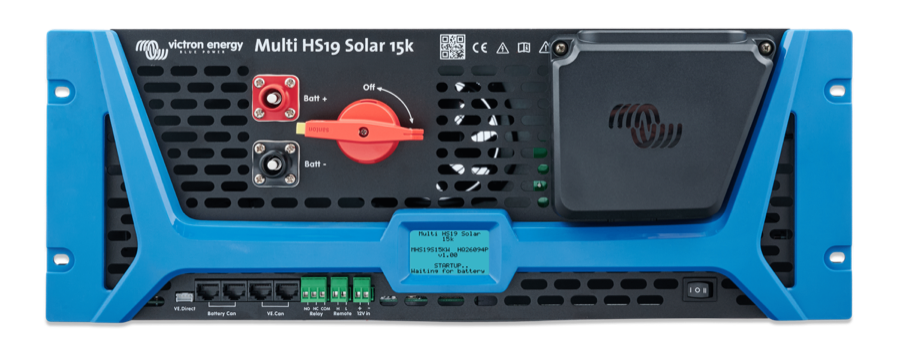
Victron · high voltage · three-phase ESS
Victron Multi HS19 Solar 15 kW for commercial BESS
Multi HS19 Solar 15k brings the Victron ecosystem into a high-voltage three-phase architecture. It is a candidate for compact C&I ESS only when the exact battery voltage window,…
Open decision page →First step without choosing a brand
Tell us what must not stop and what the system must deliver.
We start with data, project boundaries and the decision. The bill of materials follows power, energy, risk, legal and service review.