
Technical claims checked against primary manufacturer sources · 2026-09-03
What is genuinely new
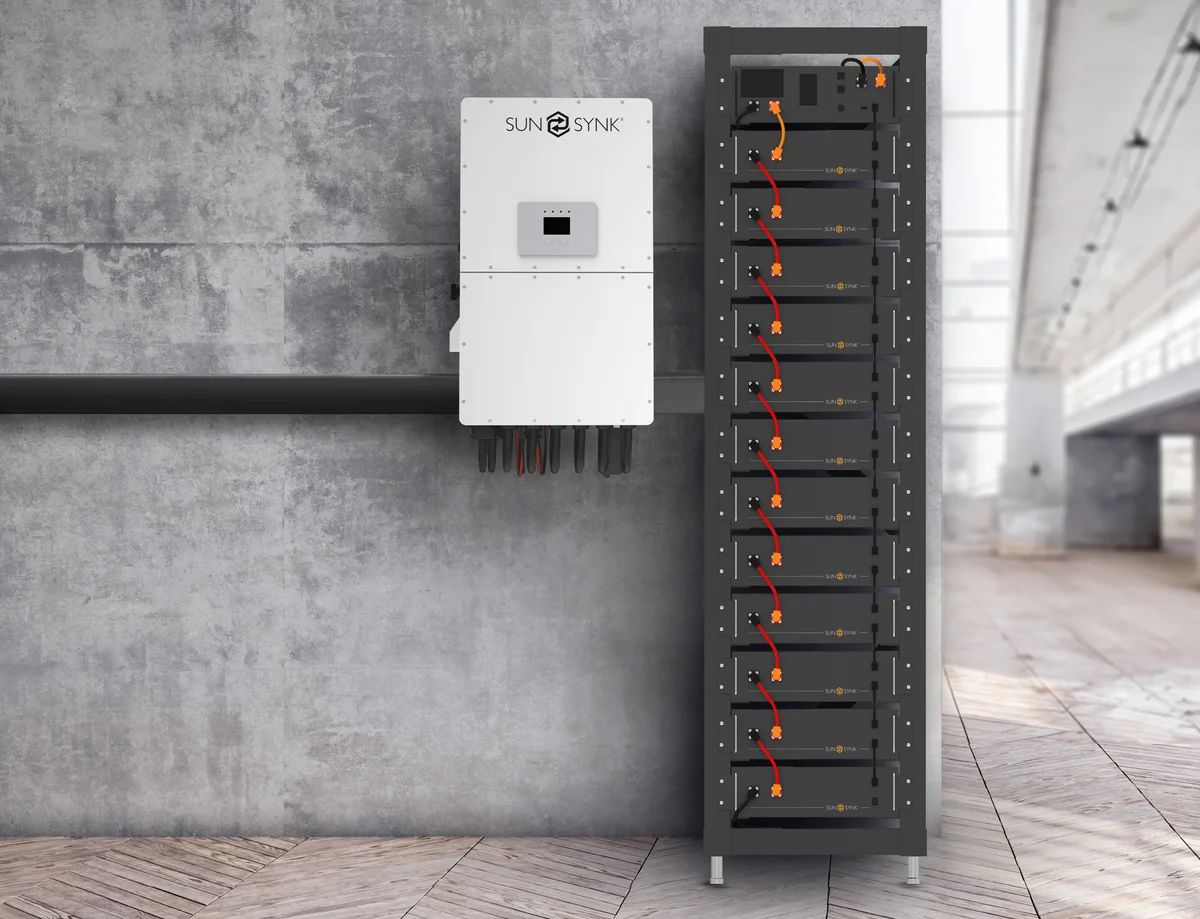
Sunsynk public communications show a move beyond residential hybrids towards a broader C&I portfolio and the BESS range. Its official catalogue also lists an 80 kW, three-phase, high-voltage hybrid inverter, model SUNSYNK-80K-SG02HP3-EU-EM6. This is a relevant signal for compact storage, solar retrofits and local resilience, but it is not proof that every requirement of a Czech or EU project is met.
An 80 kW rating does not establish duration, phase-unbalance behaviour, BMS communications-loss response or black-start capability. The word “hybrid” cannot replace a single-line diagram, protection coordination and an evidenced grid-connection mode.
Where the architecture may fit
A typical candidate has on-site solar, a measurable quarter-hour demand peak and a requirement for export limitation or controlled backup. We compare interval data, required power, duty duration, SOC reserve, cycling frequency and the value of lost load. Parallel operation and single-fault behaviour are assessed separately.
A C&I BESS is more than a compatible inverter and battery. Accountability must be defined across BMS, PCS, EMS, protection, communications, remote access and service. Spares, fault escalation and configuration recovery also belong in the binding scope.
RLHS qualification gates
Before recommendation we require the exact European model and revision, current documents for the intended mode, written compatibility for the battery and firmware set, and calculations for DC currents, fault levels and thermal conditions. Fire strategy, grid requirements, remote administration, identities, logging and updates follow.
FAT and SAT must measure power and energy inside the agreed SOC window, EMS response, communications loss, emergency shutdown, island transition where promised and safe recovery. Without that evidence an 80 kW inverter remains a component, not an operating result.
Commercial conclusion
The Sunsynk 80 kW HV can be a credible candidate for small and medium commercial BESS projects. We do not offer it as a universal package or preselected winner. We define the problem and comparable duty first, then evaluate Sunsynk against an alternative PCS/BESS architecture on risk, service and whole-life cost.