
Technical claims checked against primary manufacturer sources · 2026-09-03
What is built in
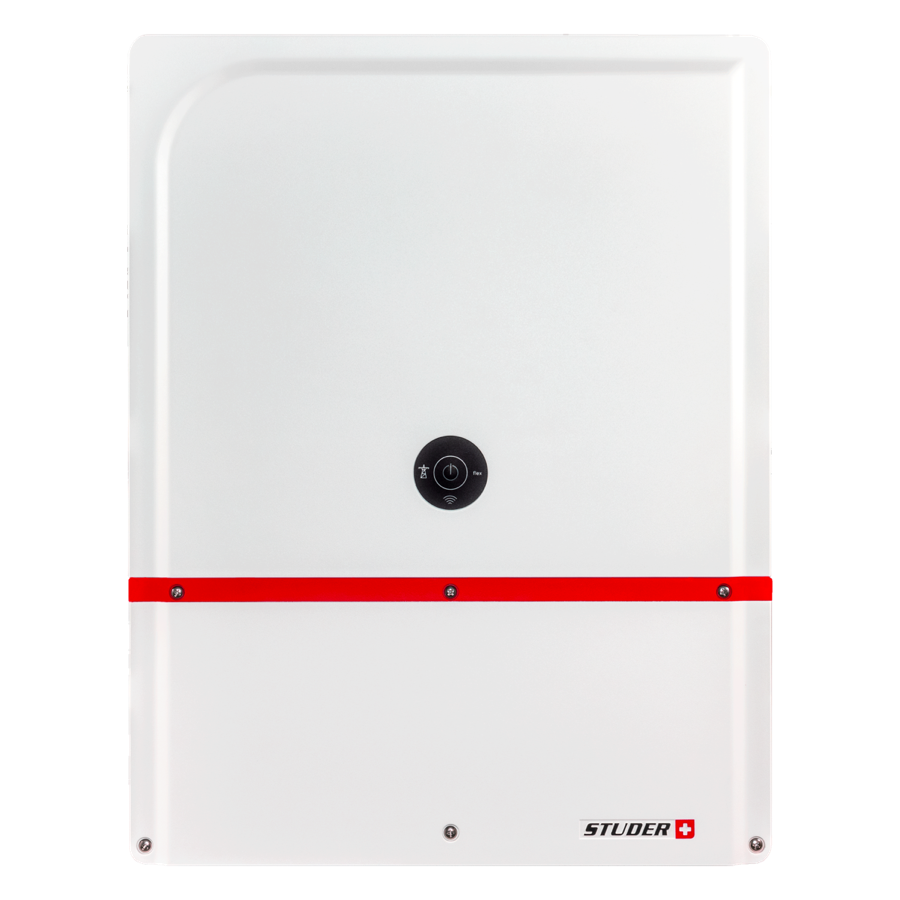
The official next1 page describes a single-phase 6.5 kVA inverter-charger for 48 V batteries and systems of up to six units, or 39 kVA. It lists an access point, Wi-Fi, Ethernet, web interface, CAN BMS, Modbus RTU/TCP and USB. nextOS runs in the device, with open Modbus/API integration for more complex systems.
Consolidation can remove gateways, cabling and some failure points. It also means a firmware or object-model change can affect monitoring, EMS and supervisory automation. The exact model, firmware, register map and accepted configuration must therefore form part of the project record.
Where next1 may fit
The platform is relevant to backup, off-grid operation, retrofits, local microgrids and systems with a generator or controllable AC load. Studer describes AC flex as a second source or controlled load and supports multiphase arrangements with multiple units. The exact project must still verify applicable grid certificates for its country and mode.
For a commercial facility we separate critical and non-critical circuits, transfer-time needs, motor starting, available fault power, battery reserve and controlled recovery. A parallel system must be tested for the loss of one unit and the communications layer.
Modbus and change control
Addresses, data types, scaling and write permissions must match documentation for the installed version. Every writable point needs an owner, range, safe default and an inhibit condition. The EMS must not bypass internal protection and must recognise stale or poor-quality data.
Before an update we store configuration, register mapping, versions and a reference operating state. Afterwards we repeat communications, alarm, charge, discharge, power-limit, generator-control and recovery tests. This turns “smart integration” into an auditable system.
In practice we recommend a separate control-network segment, limited accounts and documented remote access. An open interface is not a reason to expose administration to the public internet; access to power commands must be restricted, attributable and revocable.
RLHS conclusion
Studer remains an important service and integration competence for systems we have worked with for many years. next1 provides useful interface modernisation, but is not an automatic fit for every C&I BESS. We assess duty, certification, battery, service route and whole-life cost; large BESS requires a separate architecture.