
Content and sources checked 3 September 2026
FAT starts in the contract
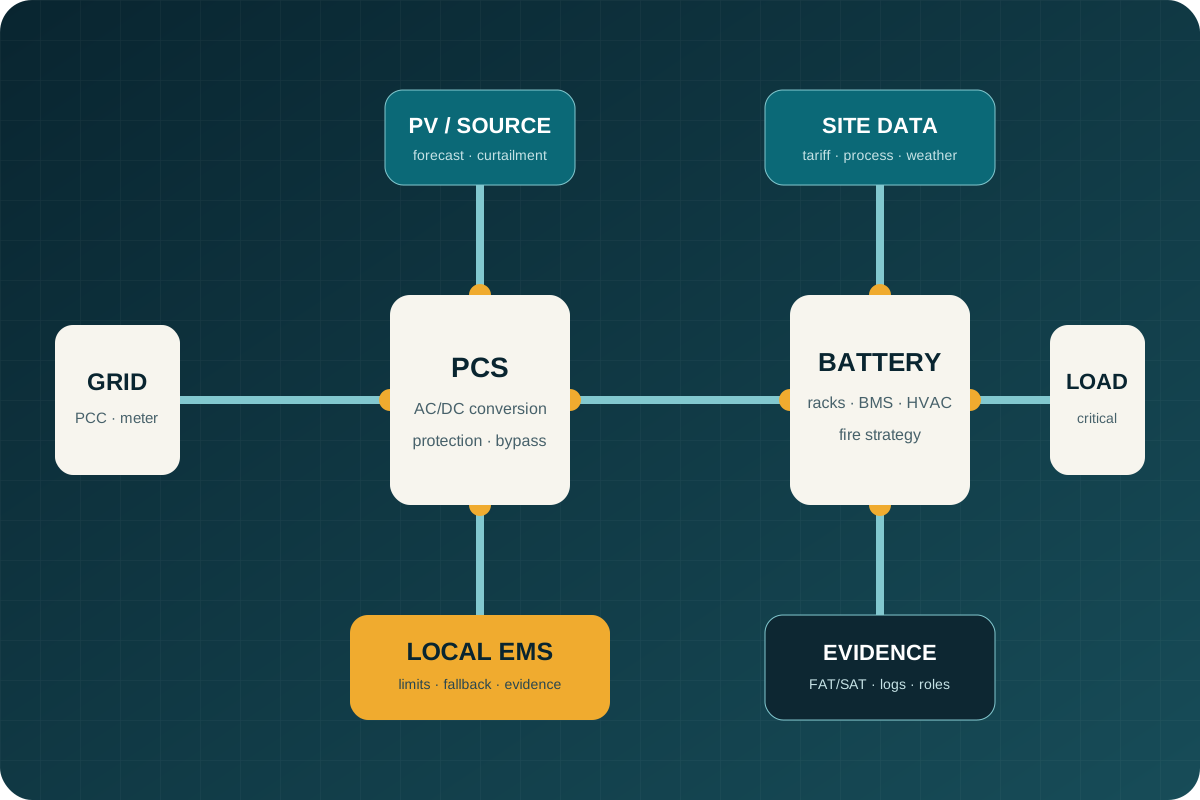
Factory Acceptance Testing only works with an agreed system boundary, hardware and software versions, simulated inputs and acceptance criteria. The owner must know whether the battery, PCS, EMS or integrated system is under test and which site functions can only be simulated before shipment.
The test matrix links requirement, initial state, action, expected response, tolerance, logged signal and responsible witness. Failure creates a defect, corrective action and repeat test rather than disappearing inside a generic “system operational” report.
What FAT should test
We verify battery, BMS, PCS, EMS and gateway identity and revision, protection and power settings, charge and discharge, measurement accuracy, time synchronisation, alarms and user roles. Scenarios include lost BMS/PCS/EMS communication, stale data, cloud loss, thermal derating, emergency stop and controlled restart.
Configuration and log export, backups, account inventory, change record and firmware evidence are part of the result. Products with digital elements also need an update and vulnerability route aligned to Cyber Resilience Act expectations. Cyber Resilience Act ↗
SAT connects the system to the real site
Site Acceptance Testing verifies actual protection, transformer, point-of-connection metering, grid conditions, auxiliaries, HVAC, fire interfaces and the data network. Functional tests use real site constraints such as a quarter-hour ceiling, zero export, outage reserve or dispatch signal.
Unwanted conditions matter too: internet loss, meter loss, bad time, blocked ventilation, emergency-chain opening and recovery after interruption. Each scenario defines whether the BESS stops, derates, falls back locally or requires intervention.
Capacity, efficiency and performance baseline
Nameplate capacity is not automatically the energy available at the AC boundary. The procedure defines initial SOC, temperature, power, SOC window, measurement point and treatment of auxiliary loads. That creates a baseline for warranty comparison and degradation tracking.
Tests measure available power over the required duration, EMS response, energy, efficiency, auxiliary demand and SOC recovery. Warranty KPIs specify who provides data, how gaps are treated and whether cell, DC or AC performance is being evaluated.
Documentation and regulatory handover
The handover pack includes as-built documents, settings, certificates and declarations, operating and emergency procedures, maintenance, contacts, training, open items and dates. Industrial-battery data ownership should also anticipate the battery passport from 18 February 2027. EU Batteries Regulation ↗
In Czech projects, connection and storage licensing need to be resolved before operation. ERÚ guidance from July 2026 shows that business purpose, power, grid connection and links to generation or other storage must be assessed together. ERÚ storage licensing guidance ↗
Frequently asked questions
Is a manufacturer factory report sufficient?
Not always. It must match the supplied configuration and contracted functions; site integration is demonstrated by SAT.
Is a capacity test required for every project?
Scope depends on the project, but the owner needs an unambiguous power and energy baseline for warranty and operation.
Verified sources and claim boundaries
Checked 3 September 2026. Links point to primary legal, authority or manufacturer sources. Regulatory content is technical context, not project-specific legal advice.