
Content and sources checked 3 September 2026
A local enclosure is not automatically local technology
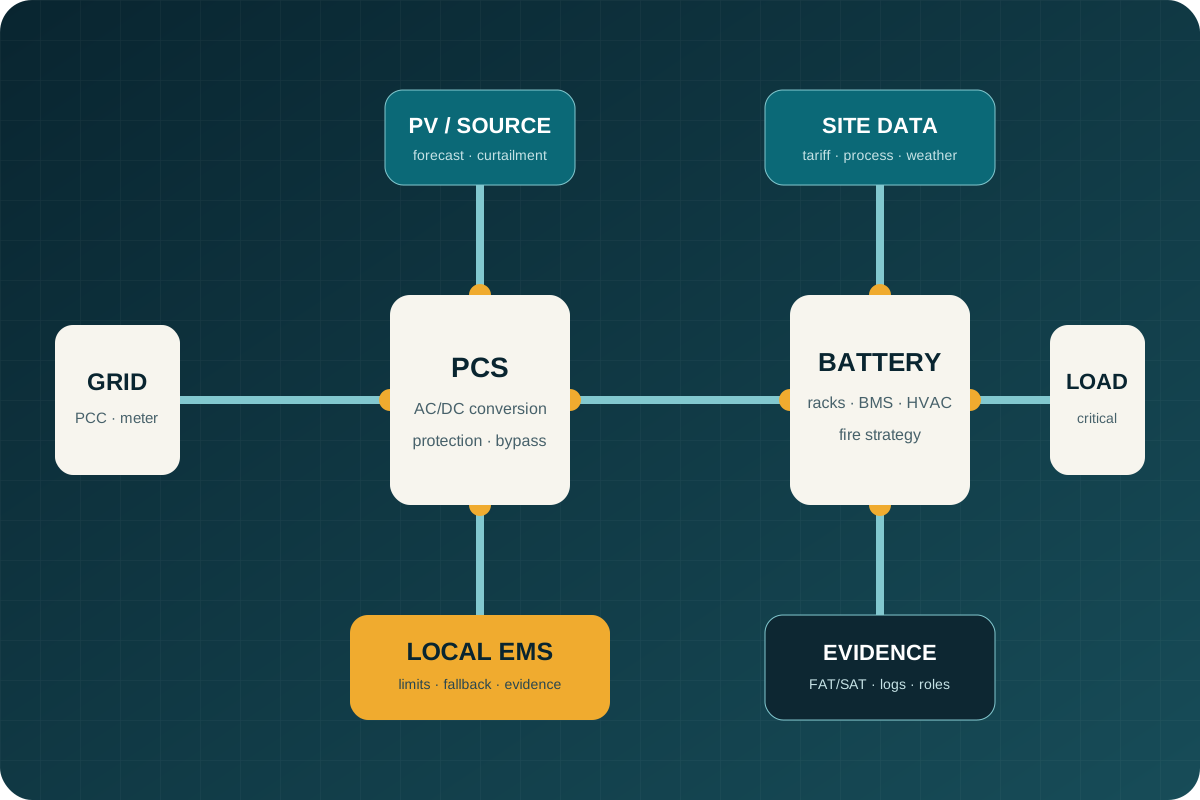
Cells, racks, BMS, PCS, EMS, gateways, cloud services and software may come from different manufacturers and countries. Local integration can add major value where the supplier understands interfaces, accepts responsibility and maintains documentation. A marketing label still cannot replace an accurate component, manufacturer, model, firmware and service inventory.
Chinese BESS should not be rejected automatically either. A Chinese platform may be technically and commercially suitable when conformity, safety, local service, data flows, updates and contractual responsibility are verifiable and when FAT/SAT and lifecycle economics pass. Country of origin is an input to risk, not the final decision.
What we request from the supply chain
The inventory names the cell or module, rack and BMS, PCS, EMS, industrial computer or gateway, network equipment, cloud and mobile application. Software evidence includes version, support period, update mechanism, vulnerability contact and, where material, an SBOM or equivalent component record.
NÚKIB supplier-trust guidance uses criteria broader than price and technical specifications, including transparency and risk governance. It was written for 5G; its ownership, jurisdiction and responsibility principles are useful as an assessment reference for digitally controlled BESS, but this is not a claim that the document legally governs battery systems. NÚKIB supplier guidance ↗
Data flows and remote intervention
A network diagram records which data leaves the site, in which direction, through which domain or address, who holds remote accounts and whether safe operation continues without cloud connectivity. Monitoring, configuration and active dispatch are separated. Supplier access cannot remain an unidentified permanent back door.
The Data Act has applied since 12 September 2025 and supports user access to connected-product data. The Cyber Resilience Act establishes lifecycle security and vulnerability expectations for products with digital elements; reporting applies from 11 September 2026 and main obligations from 11 December 2027. The responsible economic operator must determine scope for each product. EU Data Act ↗ Cyber Resilience Act ↗
Batteries, raw materials and EU duties
Regulation (EU) 2023/1542 allocates economic-operator responsibilities and introduces a battery passport from 18 February 2027 for defined industrial batteries above 2 kWh. The project therefore needs battery identity, technical documentation, market-placement roles, data and end-of-life responsibility. A QR code without reliable data is not readiness. EU Batteries Regulation ↗
Raw-material due-diligence duties under the Batteries Regulation were postponed by Regulation (EU) 2025/1561 to 18 August 2027. Procurement should distinguish that future legal date from voluntary evidence an investor may request earlier. Regulation (EU) 2025/1561 ↗
Communicating origin without misleading the buyer
A website and proposal should state what the company developed, what it integrates, what it imports and who provides cloud and warranty. “Locally designed control logic integrated with manufacturer X cells and PCS” is more useful than an undefined “local battery”. Transparency helps the owner assess service and concentration risk.
Our assessment does not preselect a country or brand. It sets conditions every candidate must meet: documentation, data access, vulnerability process, enforceable contracts, service, technical function and whole-life economics.
Frequently asked questions
Is a Chinese BESS automatically unsafe?
No. Origin is one factor; actual components, conformity, cyber processes, service, contracts and test evidence determine the result.
Is “local development” enough evidence?
No. The owner needs to distinguish original development, integration and the origin of critical components and digital services.
Verified sources and claim boundaries
Checked 3 September 2026. Links point to primary legal, authority or manufacturer sources. Regulatory content is technical context, not project-specific legal advice.
- NÚKIB – Recommendation for assessing supplier trustworthiness ↗
- European Commission – Cyber Resilience Act ↗
- European Commission – Data Act ↗
- EUR-Lex – Regulation (EU) 2023/1542 concerning batteries and waste batteries ↗
- EUR-Lex – Regulation (EU) 2025/1561, postponement of battery due-diligence obligations ↗
- NÚKIB – Guide to Act No. 264/2025 Coll. ↗